

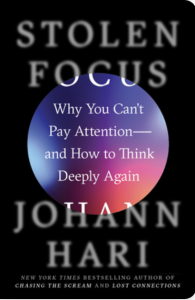
Compellingly written, and made me think, though I certainly didn’t agree with all of the author’s arguments (and as the book went on, the scope of the book just seemed to get broader and broader).
I thought, going in, that this was a book about how social media, technology, and our fast-paced society has robbed us of our ability to be in the moment and to think deeply–something I already believe. This was true for about the first half of the book. The author told his own story of how this had happened to him, how he’d taken a technology sabbatical, and what the “detox” experience was like.
What I didn’t care for was the fact that the author seemed to contend that it was both short-sighted and even cruel to argue that each of us can make the same choices he did to counter these effects. He argued that many of the underprivileged (or maybe he said disenfranchised, or pick your favorite politically correct term) don’t have the time or money or life situation that might enable them to do such things. (There might have been something about white privilege in there, I can’t quite recall, but if that phrase wasn’t in there then the concept sure was.) So basically, we’re all victims — of our life situations, of the food we’re given, of the society and culture to which we belong. His solution to this was for those of us who have the bandwidth to do so, to push for political change, grassroots style, in all of these myriad areas of society and culture.
To me, this seems both more overwhelming for those who “can,” and also disempowering for those who “can’t.” Anytime a person categorizes themselves as a victim, they’ve shut down all possibility of agency or change.
So while I didn’t care for his action items at all, I thought the actual information presented was compelling and well-written.
My rating: ***
Language: none that I recall
Sexual content: none (nonfiction)
Violence: none
Political content: quite heavy and eye-rolling in places


Leave a Reply